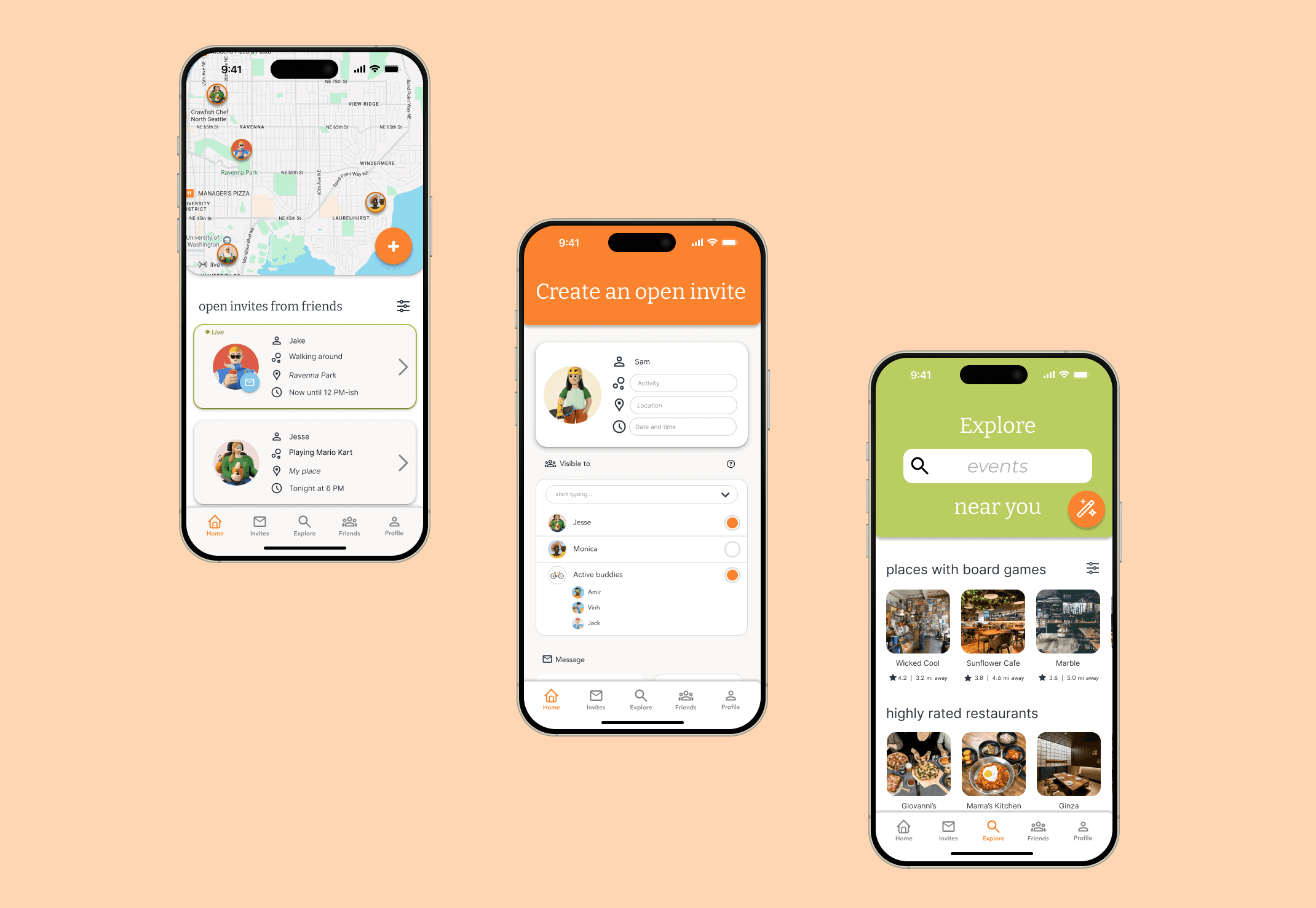
Join - A Social Planning App
Join began as a personal passion project sparked by a small but familiar friction: spontaneous plans often take more coordination than they should. My husband and I noticed that when you want casual company—whether for coffee in an hour or a last-minute activity—you’re suddenly juggling multiple messages, timing, and ideas. And even if coordination isn’t the issue, deciding what to do or where to go can stall the momentum.
I wanted to design a tool that makes getting together feel effortless. Join is a concept app that supports everything from quick, low-pressure hangouts to discovering restaurants, events, or simple at-home ideas with friends. It reduces the back-and-forth so people can spend less time planning and more time actually connecting.
Goal
Design an app to simplify and enrich the process of scheduling spontaneous hangouts with friends.
Process
1. Initial Exploration & Problem Framing
I began by reflecting on real-world moments where coordination became a barrier—both in my own life and in casual conversations with friends. This helped refine the core question: How might we make last-minute hangouts feel effortless rather than effortful?
2. User Insights & Informal Research
To ground the problem, I gathered informal insights about:
How often people meet up spontaneously
Whether group messaging feels burdensome or easy
What typically stalls planning (timing, ideas, uncertainty, etc.)
How people choose places or activities when they’re unsure what to do
3. Defining Key Features
Based on these insights, I identified essential functions the app needed to support:
Quick, low-pressure hangout invitations
Real-time availability sharing
A lightweight event/restaurant/activity discovery flow
These became the backbone of early design exploration.
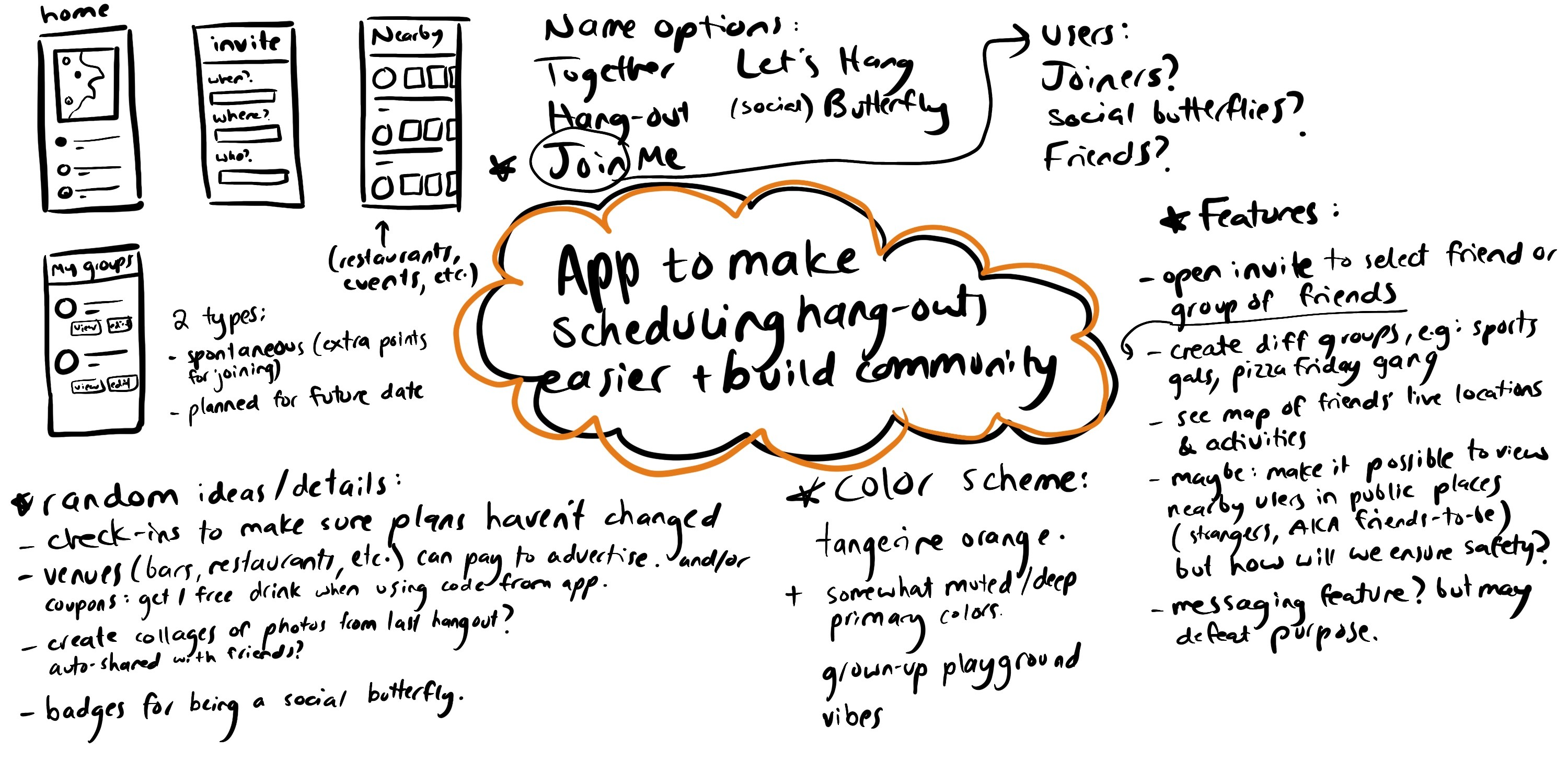
4. Sketching & Concept Development
I translated the feature set into rapid sketches to explore different interaction models. I tested several approaches to inviting friends, surfacing suggestions, and representing availability.
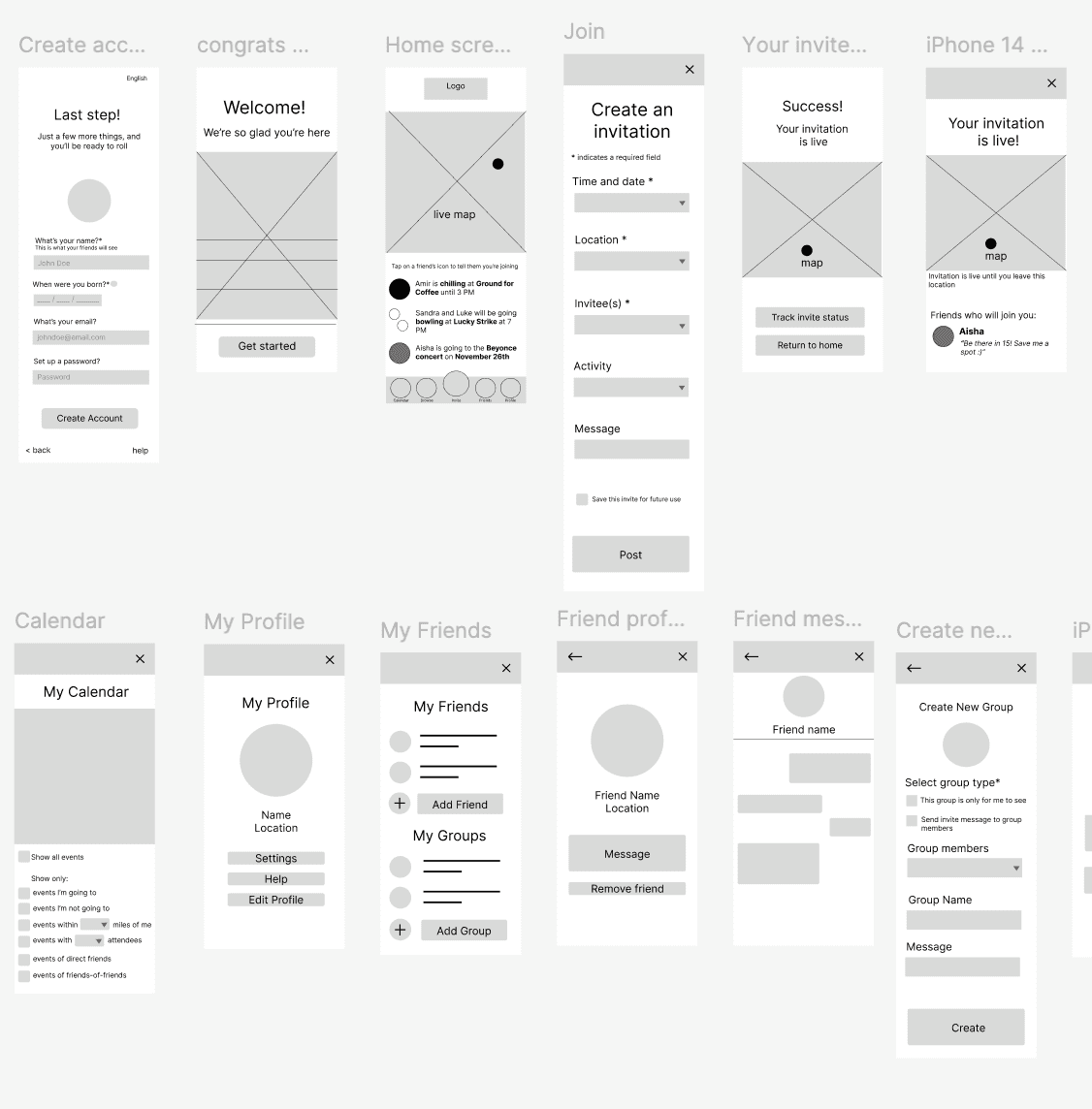
5. Wireframing & Flow Mapping
Once I narrowed the concept, I created mid-fidelity wireframes to map the core experience end-to-end, focusing on:
Minimizing cognitive load
Keeping social pressure low
Reducing unnecessary steps
6. Visual Design & Prototyping
I selected a vibrant, warm color palette inspired by playgrounds—spaces many of us associate with our earliest spontaneous, joyful hangouts. I paired this palette with rounded corners and soft visual treatments to create an inviting, human feel rather than a rigid, overly digital one. The invite cards are designed to subtly echo physical invitations tucked into envelopes, reinforcing a sense of intention and anticipation as users open them.
7. Feedback & Iteration
I shared the prototype with peers to gather quick feedback on clarity, tone, and usability. Insights from these conversations shaped refinements in both the interaction flow and the language used throughout the app.
Outcome
Through user interviews and iterative design, I identified key barriers such as fear of rejection, uncertainty about others’ availability, and the cognitive load of coordination.
The final prototype features:
A real-time availability map that lets users see which friends are open to hanging out nearby.
An "open-invite" system for low-commitment, spontaneous invitations.
An Explore page offering local events, restaurants, activity ideas, and an AI assistant for moments when users need inspiration.
Early feedback showed that participants appreciated how the app made it easier to act on spontaneous social impulses.
What I Learned
This project deepened my understanding of end-to-end product design—from research and behavioral insights to branding, business considerations, wireframing, prototyping, and the value of iterative refinement. It broadened how I think about emotional UX and the social dimensions of usability, lessons that continue to shape my practice.